Showing posts with label reading recommendations. Show all posts

Tuesday, January 05, 2021

Geezer Alert! (Memories on a Tuesday afternoon)

DEC PDP-8 computer next to Blutarsky from Animal House, with pencils up his nose

I don't remember my first experience of programming computers. Close to the beginning, though, for sure, was a course I took in my junior year of high school (c. 1976), where we learned how to write BASIC programs that ran on a DEC PDP-8, I think it was. There was one terminal, which displayed both what you were typing and your program's output on yellow paper, a giant roll of which lived in a cardboard box, below the terminal.

I do vividly remember the first time I made money programming. It was right around that time, probably a school break six months later, when I was asked by my friend's father to put together something that would display bar charts and stuff like that. In this case, I was using his Apple computer (model number long since vanished from memory), which hooked into the TV and used a cassette tape recorder to store programs. He paid me $10 for four hours' work, which was a considerable bump from what I had ever made before that; e.g., about a $1/hr for a paper route, babysitting, and lawn-mowing, maybe $1.50/hr for caddying.

The money was nice, but it wasn't the most important thing. Computers were just ... pretty cool, and the thought that it was not inconceivable that I could someday get paid for playing with them? Well, as I said, still a vivid memory.

Fast forward to the time that they became magical.

After having been excused from further attendance after my sophomore year in college ("Mr. Blutarsky: 0.0"), I still hung around with my erstwhile classmates over the next few years. Mostly in bars, admittedly. But for some reason, one night, I went with one of them to a class, which was an introduction to Lotus 1-2-3. Looking at the Wikipedia article, I now realize that this must have been very near the initial release, well before it became the proverbial killer app. Anyway ...

omg

To be able to put a number in one cell, and then a formula in another cell that referred to the contents of the first cell, and displayed the result in place, and then instantaneously updated when you changed the first cell? That was when I got hooked.

I said magical, but it was something else, too. It felt like I was privy to a sorcerer's secrets. I could make something happen that looked magical, but it was, behind the curtain, absolutely, 100%, purely logical.

What brought about these memories?

A fascinating article by Amy Peniston, posted just a week ago, in which she describes her observation of ...

... a radical shift in data analysis methodologies. Excel-based models, which had seemed top-of-the-line suddenly were too slow and too rigid; Integration with 3rd party data sources, which was once a luxury, became the norm; And analysts began to utilize scripts to accomplish many labor-intensive tasks typically performed by hand or in spreadsheets.

Enabling this change is a suite of accessible Python-powered tools.

I apologize if that punchline didn't knock you off your couch, or home barstool, or ergonomically correct desk chair, or what have you. So let me tell you that there's more! She observed these changes while working in ... wait for it ... the reinsurance industry.

Wait, what? Still not sold?

Ah, well. Such is the lot of the nerd. But thanks for reading all the way through.

(h/t: PyCoder's Weekly)

Wednesday, March 25, 2020

No Goings On

Most times, when I read The New Yorker, I skip, or at best, skim, the opening section, Goings On About Town. I feel mildly guilty about this, as though I'm a boor who waves off all of the culture available to me, just a short train ride away, not to mention a spoiled brat who ignores the work that went into reporting on it all.

Sometimes, I take comfort in the existence of this section, thinking that if I have had the foresight to bring an issue of The New Yorker with me to a place where I'm going to have to wait, and I have read all of the articles in it, and my waiting time is still not up, then I'll always have Goings On About Town to fall back on.

Yesterday, around 1pm, I called my regular place to ask if I could bring my car in for a while-I-wait oil change. Ralph, the owner, said, "Uh, I'm actually not there. I forwarded the phone to my cell. I sent my guys home and closed up at noon. I only sold sixty-eight gallons of gas all morning."

Turned out he was fine with my coming by this morning, so I did, and even though I had to be there at the ungodly hour of 9am, I had had just enough coffee to remember to bring the latest (Mar. 23, 2020), as yet unread, issue of The New Yorker. Got to the station, handed over my car key, settled in to wait. Opened the mag ...

screenshot saying 'As a result of the coronavirus crisis and the closing of New York City venues, Goings On About Town will not appear this week.'

Okay, not to worry. How long could an oil change take, when I was the only customer in the place? The Talk Of The Town was good. Thoroughly enjoyed the first of the long articles, by Jill LePore, on the census, But Who's Counting?, and the second, by James Somers, on the study of avalanches, Cold War. Had just started the third, Emily Nussbaum on Fiona Apple, Skin In The Game, when Ralph came into the waiting area. Oil change was all done. HOWever. I did need an air filter. And a new belt. And a brake job. I asked if they could do it now. He said, sure, and that it would take about two hours.

As is usual with this fine place, he offered to give me a ride home and then come pick me up when the job was done. A small part of me felt like social distancing ought to apply (why be in an enclosed car with someone else, if you don't have to be), and a large part of me did not want to take him up on his usual generosity: since there was a skeleton crew in place, just Ralph and one mechanic, I thought it might stress him out to have to be away, even for ten minutes. So, I said, "No, thanks. Appreciate it. But I don't mind waiting." I went outside for a cigarette to go with the complimentary cup of coffee and contemplated time spent reading so far, approximate number of pages left, odds that I was going to like any of the rest of the articles, having totally scored on two already, thought about the missing Goings On About Town, and tried to remember if I had seen anything else to read in the waiting area. Aside from signs on the wall and hanging bags of snacks, I could not think of anything. Not even a tube of toothpaste [1]. I suppose anxiety would be putting it a bit strongly.

In the end, all the work was done before I got to the end of the magazine, and it only cost me $700 for an oil change! #winning

P.S. Weird thing when I got home and checked the snail mail. When I opened my box, I saw a new issue of The New Yorker. Dateline? Mar. 16, 2020. Well, it is the Styles Issue. I suppose it's appropriate that it's fashionably late.

Wednesday, May 28, 2014

Lines of the Day: 2014-05-28

A couple of passages from a great and horrifying book I just finished, Patrick McGuinness's The Last Hundred Days, a novel set in Romania at the end of the Ceaușescu regime.

... I grew to hate, and it energised me. But I couldn’t make a life out of it, or not a life that was my own. So I discovered forgiveness, and the secret malice of it: people forgive not out of grandeur of spirit but as a way of freeing themselves. The forgiver always floats free, the forgiven slides a little further down the soft shute to hell. Maybe that’s why so many religions use forgiveness as a secret weapon.

__________


‘Ah, Monsieur Midwinter? Gilbert, isn’t it?’ Ozeray loomed up between us and closed his fingers around Wintersmith’s hand.

‘Er… Wintersmith, Giles.’ The Belgian had him in a diplomatic half-nelson.

‘Ah yes, quite so. I could not help overhearing your wise analysis. I remember when I was just beginning my diplomatic career.’ Ozeray paused and closed his eyes, inviting us to join him in a prehistory where diplomats and dinosaurs roamed the same mirrored banqueting halls, ‘my mentor, Baron Henri Nivarlais, – a great diplomat – oversaw fifty years of the most radical change the world has known without batting an eyelid – the Baron, he said to me: “Young man, in diplomacy there are two kinds of problem: small ones and large ones. The small ones will go away by themselves, and the large ones you will not be able to do anything about. The biggest challenges in your career will come from the temptation to act. The test of your mettle will be how nobly you surmount it.” Very fine advice, Mr Midwinter, do you agree?’

Saturday, November 23, 2013

Oh, this is such a good read

Frank Chimero has written up and posted a version of a talk he recently gave, called "What Screens Want."

His talk was (ostensibly?) aimed at web developers, but there's no way you need to fit into that slot to follow it, or to love it.

Just for example, how's this for empathy, for every plain ol' computer user out there?

Computers, after all, are just shaky towers of nested abstractions: from the code that tells them what to do, to the interfaces that suggest to the user what’s possible to do with them. Each level of abstraction becomes an opportunity to make work more efficient, communicate more clearly, and assist understanding. Of course, abstractions also become chances to complicate what was clear, slow down what was fast, and fuck up what was perfectly fine.

And this?

So what is the answer? I found this quote by Ted Nelson, the man who invented hypertext. He’s one of the original rebel technologists, so he has a lot of things to say about our current situation. Nelson:

The world is not yet finished, but everyone is behaving as if everything was known. This is not true. In fact, the computer world as we know it is based upon one tradition that has been waddling along for the last fifty years, growing in size and ungainliness, and is essentially defining the way we do everything. My view is that today’s computer world is based on techie misunderstandings of human thought and human life. And the imposition of inappropriate structures throughout the computer is the imposition of inappropriate structures on the things we want to do in the human world.

Emphasis mine. [...]

Also, to illustrate some of what he's saying, Frank has clips from James Burke's Connections, Eadweard Muybridge's work with horses, and The West Wing. Featuring CJ. I mean, the shared nerd porn interests alone ought to do it, don't you think?

Go, and enjoy.


(h/t: Jenna Wortham, via a Scuttlebot post which was presented as a sidebar on the NYT's Bits blog, which I saw while reading a note about Twitter and Perfect Forward Security, and omg, when the h/t is getting to be longer than the post, it is waaay past time to click the Publish button)

__________


[Added] Of course the first blockquote above reminded me of one of the classics from the mesozoic (when we had just evolved from hamsters running along wires strung between tin cans, and thence onto typewriter keyboards, and were suddenly able to sign up for Automatically Delivered Email Newsletters), Joel Spolsky's post "article," The Law of Leaky Abstractions. Joel does eventually get into specific programming examples, but don't let those throw you, if you're not a programmer. The opening, the general ideas, and most importantly, the view of what today's programmers face when trying to relate to non-programmers are well worth your time, especially if you liked Frank Chimero's piece. Even if the words are more than *gasp* ten years old.

Wednesday, August 21, 2013

Out of pocket

Either I forgot it completely, or somehow never read this one back when I was all about Marlowe, but I just finished Lady in the Lake a couple of nights ago. It was a great read, as is everything in the terribly small Raymond Chandler canon.

Among the delightful archaic terms encountered: our hero reports at one point checking his strap watch.

Are you able to name any other extinct retronyms?

Friday, August 16, 2013

Saturday, February 23, 2013

"The Extraordinary Science of Addictive Junk Food"

Erick EricksonA longish but fast-paced article that's worth a look, if for no other reason than to satisfy your cravings for sick fascination. Probably you already have a sense of much of what's touched on, but some of the specifics, not to mention the corporate attitudes on display, deserve to be front and center in your thoughts for a while.

The article, by Michael Moss, is adapted from his book Salt Sugar Fat: How the Food Giants Hooked Us, which is featured on his website.

On a tangential note, visiting his site introduced me to a new button:

IndieBound may interest some of you. There's a handy independent book sellers finder page, for example.

(top pic. source)

Saturday, February 16, 2013

Best article about architecture I've read in quite some time

This is probably going to sound like I don't know much about art, but I know what I like, but despite my love for building and buildings, I usually find writing about architecture tedious in the extreme, pretentious pages that take forever to say nothing at all.

Not this time. David Owen's New Yorker piece, "The Psychology of Space," is an utter delight. It's nominally about a Norwegian firm, Snøhetta, which has been hired by New York City to redesign Times Square, to make it more appealing to pedestrians, but there's a lot more fascination at hand.

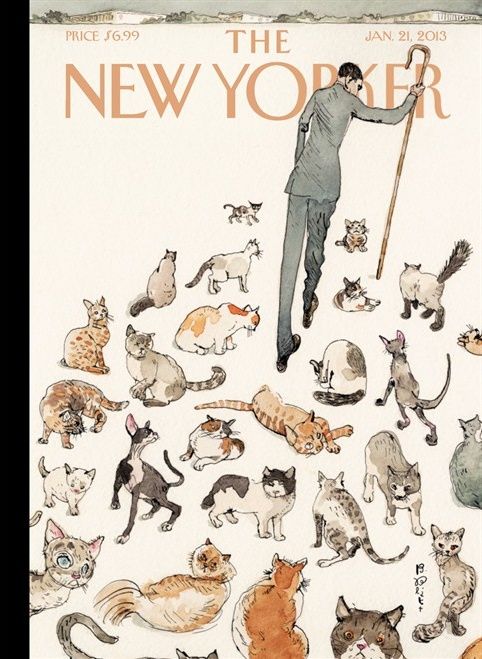
Sorry that the full version isn't available online to non-subscribers, but maybe you can find a print version of the 21 January 2013 issue at the library, or in the smallest room in the house of one of your elitist friends. Look for the cover featuring the newly inaugurated president dealing with Congress.

Saturday, December 29, 2012

The Jon Swift Memorial Roundup 2012 #jonswift2012

Friend of lowly bloggers everywhere, Batocchio, the Vagabond Scholar, has once again put in a bunch of time soliciting and assembling "the best blog posts of the year, as chosen by the bloggers themselves." This is, of course, a tradition started by the late great Reasonable Conservative, and it is carried on in his memory. And you even get to start off with a cat pic!

You might thank Batocchio on Twitter, and join in the discussion using the hashtag #jonswift2012.

Happy reading!

Sunday, December 09, 2012

M.B. on 12/7

In Comments under this past Friday's post, M. Bouffant refers us to another one of his, posted five years earlier. It's about his father's experiences on that day in 1941. Definitely worth a read. Plus, more pix here.

Friday, August 17, 2012

Some people around the breakfast table, talking

"Holy Moly." It's quick. It's good. Go now.

Sometimes, you like an article just because of the way the words are arranged

I clicked on a link hoping to see some boobies … oh, c'mon, that's not why. This is the New York Times.

I clicked on a link expecting to sneer at some bluenosery, due to the blurb ("Bared flesh is common in experimental modern dance. And sometimes — infrequently — it succeeds."), but I was happily surprised by Alastair Macaulay's "Nakedness in Dance, Taken to Extremes." Here are just three of the reasons why.

• I am now aware of the pejorative term Hooray Henrys.

• I just love inside baseball asides, even when I have no idea what they mean, just because the precision sounds so good: “Crotch (all the Joseph Beuys references in the world cannot heal the pain, confusion, regret, cruelty, betrayal, or trauma....)”

• A rare sensible statement on art versus porn:

When I tell friends of these viewings, they inevitably ask: Where is the line between art and pornography? But there’s always been a huge overlap between the two; you can see scenes of copulation on Greek vases and Indian temples. What’s more, many works of art have seemed pornographic without nakedness. Many of us are tempted to talk as if art = good, pornography = bad. Yet that’s wrong too. Much art is poor, while the novels of the Marquis de Sade are pornography taken to a brilliant, horrifying and extraordinary peak.

The entire article is much more graceful than snippets presented in bulleted list form would suggest. Go read, for pleasure. And rejoice in your membership in the cultural elite, or at least your want to be.

(?)

Sunday, July 29, 2012

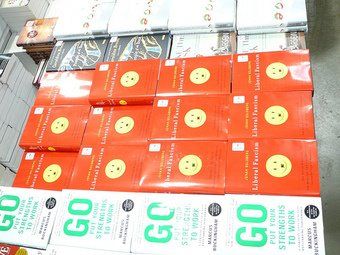
Always a delight to have a wrap-up of Jonah Golberg's recent (in)activity

A pallet full of remaindered copies of 'Liberal Facism'Made my afternoon. Thanks, Pareene!

And this I did not know:

Alex Pareene's annual Hack List is so popular -- and useful -- we thought we should spread it out over the year. This column is a regular feature taking a deeper look at our media's most pernicious hacks, which we'll rank in order at year's end.

Bookmark that, because obviously. And here's the complete 2011 Hack List, in case you missed it.

(pic. source)

[Update 2021-09-21 13:46] Backup copy of image (because old image host is going sour):

"The Conversion of a Climate Change Skeptic"

CALL me a converted skeptic. Three years ago I identified problems in previous climate studies that, in my mind, threw doubt on the very existence of global warming. Last year, following an intensive research effort involving a dozen scientists, I concluded that global warming was real and that the prior estimates of the rate of warming were correct. I’m now going a step further: Humans are almost entirely the cause.

My total turnaround, in such a short time, is the result of careful and objective analysis by the Berkeley Earth Surface Temperature project, which I founded with my daughter Elizabeth. Our results show that the average temperature of the earth’s land has risen by two and a half degrees Fahrenheit over the past 250 years, including an increase of one and a half degrees over the most recent 50 years. Moreover, it appears likely that essentially all of this increase results from the human emission of greenhouse gases.

These findings are stronger than those of the Intergovernmental Panel on Climate Change, the United Nations group that defines the scientific and diplomatic consensus on global warming.

That is the beginning of an op-ed by Richard A. Muller which is well worth reading in its entirety.

If you don't know Muller, the short version is that he was for some time the darling of the denialists, being the most credible critic of climate change research, a rare person who could legitimately be called a skeptic in the best scientific sense. In April of 2011, he became dead to the denialists. The op-ed is a distillation of the findings he first reported then, and of follow-up work since.

Those bent on denialism may try to cherry-pick some fragments from the end of the op-ed. If so, maybe I can save them some typing by stating that I don't dispute anything from the end, any more than I do from the lede. What I would really like is not to blunder into some wild set of programs pushed by the most zealous alarmists, but to get to a rational starting point, where everyone agrees on Muller's fundamental conclusion.

Finally, to the so-called agnostics: Yes, you could still make the case that this is yet another argument from authority, that you will insist that you remain unpersuaded because you haven't had the time to study the problem yourself. If so, so be it. But I do wish you would ask yourself how many other aspects of life you accept, entirely because the experts in those fields have converged.

(h/t: Jack, via email)

__________


[Added] You'll be shocked, shocked to see that Andrew Revkin has rushed about gathering up brickbats for Muller, but you might find some worthwhile bits, if you're the sort who follows this Debate© closely. (h/t: John Horgan)

[Added2] Also via Jack, a delightful catch from Roy. Connoisseurs of homo wingnuttia are encouraged to follow the links Roy offers to the Power Tool blog posts, but this bit from the second one is just too good not to quote:

Hmm, maybe the Kochs are actually interested in good science after all, and perhaps their critics might want to give some benefit of the doubt to other Koch-supported research projects?

Man. Lipstick on a pig doesn't even come close.

Thursday, June 28, 2012

Prescriptivist Descriptivist Fight!

I was going to go with PDF! as the title, but I figured none of you would click on that. Even with an exclamation point. Who wants to hang the browser, or launch a hellabyte download?

Anyway, a very fun piece by Joan Acocella, from a few weeks ago due to my dead trees reading lag, in The National Review.

Monday, April 23, 2012

"American electoral politics: a brief introduction"

An oldish Bérubé piece that I somehow missed when it came out a year and a half ago. But! Nothing has changed!

Sunday, April 08, 2012

"Place Hacking: All up in your infrastructure"

A website which makes you wish awesome hadn't been killed by overuse. The only thing better than the pictures is the attitude.

(h/t: Paul Hayes, RTed by Mike Forester )

Monday, March 12, 2012

In case you missed my tweet, ...

... don't miss this outstanding post by Kay at Balloon Juice on the never-ending efforts by the Republican Party to suppress minority voters.

(h/t: @edroso and @azjayhawk47)

Tuesday, March 06, 2012

A great thing from a couple of weeks ago

(Reblogging the dead trees once again.)

I'd find it as hard to believe if you told me as you're going to right now that I'm telling you, but I'm telling you, when I got to the end of this Ben McGrath piece which starts out seeming to be about nothing special, especially given what EVERYONE was writing about a couple of weeks ago, I could only think, even in my dreams, I'll never be able to write like that.

ShareThis