Showing posts with label the magical free market sparkle pony. Show all posts

Thursday, June 11, 2015

Snort

Pretty funny caption on Deadspin, beginning:

Michelle Rhee attempts thought leadership ...

Main point of the story surprised me: I did not know that there's all this hate for Kevin Johnson. (I also did not know the two were married.)

In conclusion, charter schools still seem terrible every time reality intrudes.

Sunday, August 24, 2014

The magical free market sparkle pony gives you the bestest cheapest cell phone service!!!1!

Or, you know, not:

“Over the next decade,” Mr. Meinrath said, “U.S. consumers may overpay by over a quarter of a trillion dollars for worse levels of service than customers in other countries receive.”

USA! USA! USA!

Tuesday, March 11, 2014

Line of the Day: 2014-03-11

Still, I guess this ["hunger=dignity speech"] is a further nail in the coffin of [Paul] Ryan’s reputation as Serious, Honest Conservative. But I am of course a shrill bad guy, because I was guilty of premature anti-Ryanism — you weren’t supposed to figure out that he was a con man until 2011 or 2012.
    -- Paul Krugman

(previously in shrill)

[Added] More debunking of Ryan's speech from Jon Stewart, et al.

Thursday, January 10, 2013

Recurring, but still makes me laugh

Different car this time. Bumper sticker:


LIBERTARIAN
More Freedom    Less Government


And yes, it was parked in a handicapped parking spot.

The driver clearly needed it. I wonder if she appreciated that the spot was there for her only because of, you know, FREEDUMB-ROBBING BIG GUMMINT.

(previously)

Friday, November 30, 2012

Can you stand the excitement?

Mark your calendars. Next week, we'll be announcing the pre-order for the Atlas Shrugged Part II Special Edition DVDs.

Any bets on sales figures?

Tuesday, November 20, 2012

Everything has a firesale point

'Official Atlas Shrugged Movie Brass Money Clip'And apparently, that point has come for Atlas Shrugged Part 2, Longer, Lamer, and Even More Expensive. Big sale in the online store! says their recent email. Get cool stuff like that thing over there on the right, for 25% off! Or 40%! Or more! And they also have lapel pins! (Comments are a must.)

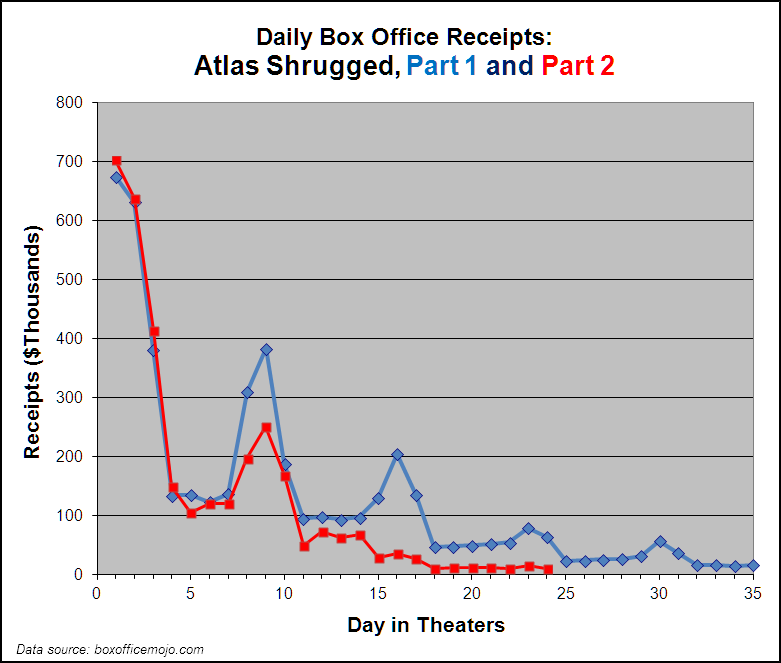
You may remember a few weeks ago, when we celebrated the results of the first ten days. I was going to update the charts several times, but for some reason, Box Office Mojo never showed any more data after Day 24. So I guess this is the final report?

Data from Box Office Mojo: part 1 | part 2


Better get in line now for tickets to Part 3!


(title: cf.)

Sunday, November 18, 2012

Probably you do not eat at any of these restaurants ...

... (your good taste already in evidence from your choice of online reading material) but sometimes, when you're traveling, especially for work, say, in a place like Orlando, Florida, you might be presented with main streets filled with corporate franchise Neighbo®hood ®estau®ants. I am speaking of places like Papa John's, Olive Garden, Red Lobster, and Applebee's. You don't want to, but there doesn't seem to be much choice, and hey, one's pretty much like another, right?

In many ways, yes. But maybe not all. So if you're a patron of any of the above, however reluctantly, I encourage you to read "A Children’s Treasury of CEOs Throwing Very Grown-Up Tantrums Over Obamacare."

Job creators? Nah. Plutocrats. And that's how they do.

(pic. source)

Monday, October 29, 2012

Deep thought

Yesterday, I watched an SUV pull into a handicapped parking spot. It had a Ron Paul bumper sticker. I wonder if the driver enjoyed the irony as much as I did.

Wednesday, October 24, 2012

Another round of shrugs

Los Angeles Times, 26 April 2011:

EXCLUSIVE: Twelve days after opening "Atlas Shrugged: Part 1," the producer of the Ayn Rand adaptation said Tuesday that he is reconsidering his plans to make Parts 2 and 3 because of scathing reviews and flagging box office returns for the film.

"Critics, you won," said John Aglialoro, the businessman who spent 18 years and more than $20 million of his own money to make, distribute and market "Atlas Shrugged: Part 1," which covers the first third of Rand's dystopian novel. "I’m having deep second thoughts on why I should do Part 2."

Eagle News, 23 October 2012:

After the box office, critical and qualitative failure of “Atlas Shrugged Part 1,” the attempt to put the entirety of Ayn Rand’s novel “Atlas Shrugged” on the big screen looked to be dead. However, through the power of having way too much money to spend, a new cast was gathered and, through hard work, “Atlas Shrugged Part 2” was made even worse than the first.

B-b-but, Part 2 opened in more than three times as many theaters!!!1!

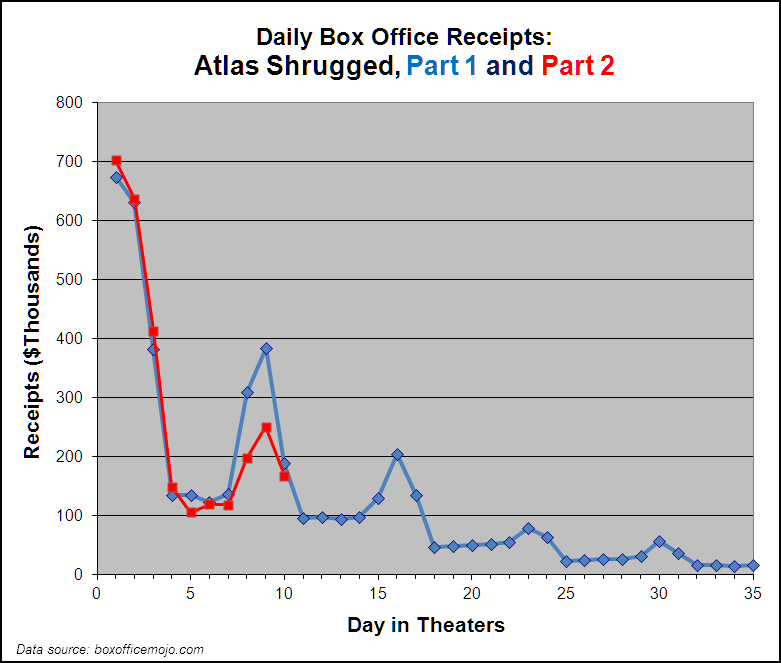
Therefore, we will make some charts, and prove to you how much better ...

Data from Box Office Mojo: part 1 | part 2


Back to Evan Maxwell, our source at Eagle News:

“Atlas Shrugged Part 2” fails in every conceivable way: from the completely hyperbolic nature of the arguments presented in the film, to the amazing lack of acting talent and to the overall lack of interesting events. Given that this movie was made despite the lack of success of “Part 1,” “Atlas Shrugged Part 3” is inevitable, and there is absolutely nothing in this movie to indicate that it will be of any quality whatsoever.

Know hope!

(previously)

[Added] Follow-up.

Friday, August 31, 2012

Line of the Day: 2012:08-31

... there should be a "minimum of 30Mbps for every remaining home and business in the country—no matter how rural or remote."
    -- a senior official in some civilized country

And it's not just nice talk. The government there is going to put up money "to support the market’s failure to deliver broadband in rural areas."

The horrors of socialism.

Monday, July 30, 2012

Chatter

Reporting from the Skynet watch:

The combined level of robotic chatter on the world’s wireless networks — measured in the digital data load they exert on networks — is likely soon to exceed that generated by the sum of all human voice conversations taking place on wireless grids.

[...]

Machine-to-machine communications has been around for more than two decades, initially run on landline connections and used for controlling industrial processes remotely. With advances in mobile broadband speeds and smartphone computing, the same robotic conversations are now rapidly shifting to wireless networks.

When the total amount of data traffic generated by machines overtakes that created by human voice conversations — or possibly before — mobile operators will have to choose who waits in line to make a call or receive an e-mail — the machine or the human.

Or, you know, the healthy competition in the telecommunications arena will cause rapid innovation and network expansion, in response to demand.

Oh, wait.

Thursday, July 26, 2012

Line of the Day: 2012-07-26

Now, there is something reasonable about a company actually being willing to cannibalize its own older offerings with something more modern. But a key warning sign that something is wrong is that they're not moving customers to something that's better and cheaper -- which is what you normally see in a truly competitive, innovative market. Instead, they're moving them to a more limited, more expensive offering. That's what you tend to see when there's not nearly enough competition in the market, and a few established players whose customers have little choice.
    -- Mike Masnick

At what point do we acknowledge that, first, there is almost no competition when it comes to providing Internet access to homes, and second, that the tubes are infrastructure, no different from roads, and start offering some public options?

Yeah, I know. Socialism.

Wednesday, June 27, 2012

All hail the free market sparkle pony!

Kate Miller, a Time Warner Cable customer in Utica, N.Y., said her 2-year-old daughter Jane has already learned the word “buffering.”

The above is from yet another story of how keeping US telecoms free of librul socialist government intrusion produces (As It Was Written) competition among them, resulting in better and cheaper Internet service for all!

Or, you know, not.

Thursday, May 12, 2011

"We turn now to an agreement between Florida State's Department of Economics and ...

... the Charles G. Koch Foundation," says an op-ed by two FSU professors (original, cached). They continue:

In 2008, the foundation signed a memorandum of agreement with FSU in which they committed to a proposed budget of $6.5 million over a period of six years, with most of the effort to be located in the economics department. The provisions called for the hiring of five professors and other staff; establishing a program for the Study of Political Economy and Free Enterprise (SPEFE) and a program for Excellence in Economic Education (EEE); and the development of educational programs for undergraduate students.

A careful reading of the memorandum reveals a number of strings attached to the "gift." [...]

This op-ed led the St. Petersburg Times to look into it, and Ed from Gin and Tacos noticed. (Ed is a professor at another college.)

PRAGMATISM vs. THE GAG REFLEX

The great but largely forgotten journalist Sydney Harris once said, "You may be certain that when a man begins to call himself a 'realist,' he is preparing to do something he is secretly ashamed of." That quote kept coming to mind as I read this:

A conservative billionaire who opposes government meddling in business has bought a rare commodity: the right to interfere in faculty hiring at a publicly funded university.

A foundation bankrolled by Libertarian businessman Charles G. Koch has pledged $1.5 million for positions in Florida State University's economics department. In return, his representatives get to screen and sign off on any hires for a new program promoting "political economy and free enterprise."

Traditionally, university donors have little official input into choosing the person who fills a chair they've funded. The power of university faculty and officials to choose professors without outside interference is considered a hallmark of academic freedom.

Under the agreement with the Charles G. Koch Charitable Foundation, however, faculty only retain the illusion of control. The contract specifies that an advisory committee appointed by Koch decides which candidates should be considered. The foundation can also withdraw its funding if it's not happy with the faculty's choice or if the hires don't meet "objectives" set by Koch during annual evaluations.

My favorite Calvin and Hobbes panel features Calvin lamenting not that everyone has a price, but that the price is always so low. [...]

Probably just a coincidence (via) that the dean of the College of Social Sciences at FSU is named ...?

David W. Rasmussen, dean of the College of Social Sciences, defended the deal, initiated by an FSU graduate working for Koch. During the first round of hiring in 2009, Koch rejected nearly 60 percent of the faculty’s suggestions but ultimately agreed on two candidates. Although the deal was signed in 2008 with little public controversy, the issue revived last week when two FSU professors — one retired, one active — criticized the contract in the Tallahassee Democrat as an affront to academic freedom.

Rasmussen said hiring the two new assistant professors allows him to offer eight additional courses a year. “I’m sure some faculty will say this is not exactly consistent with their view of academic freedom,” he said. “But it seems to me it would have been irresponsible not to do it.”

Not exactly consistent? Rasmussen, meanwhile, sang quite a different tune in a letter to the Tallahassee Democrat responding to the professors, striking a strident tone, accusing the profs of “ideological bias,” and asserting something that appears to be demonstrably untrue: [...]

We don't actually know that Dean Rasmussen is related to every conservative's favorite pollster. But we do know something: FSU's department chair is a total tool (new archive link):

Bruce Benson, chairman of FSU's economics department, said that of his staff of 30, six, including himself, would fall into Koch's free-market camp.

"The Kochs find, as I do, that a lot of regulation is actually detrimental and they're convinced markets work relatively well when left alone," he said.

Benson said his department had extensive discussion, but no vote, on the Koch agreement when it was signed in 2008.

He said the Koch grant has improved his department and guaranteed a diversity of opinion that's beneficial to students.

"Students will ultimately choose," he said. "If you believe strongly in something, you believe it can win the debate."

Benson makes annual reports to Koch about the faculty's publications, speeches and classes, which have included the economics of corruption.

Orwell wept.

Of course, FSU is still at the fluffer stage compared to another school we could name:

The big exception has been George Mason University, a public university in Virginia which has received more than $30 million from Koch over the past 20 years. At George Mason, Koch's foundation has underwritten the Mercatus Center, whose faculty study "how institutions affect the freedom to prosper."

To save the lurking glibertarians the effort of huffing and puffing that THERE IS NOTHING TO SEE HERE, we will link to ex(?)-Reason employee and perennial liberal-basher David Weigel, who says THERE IS NOTHING TO SEE HERE. (But at least he gave the backstory and the link to the op-ed.)

P.S. A Facebook page has just been launched to protest this Kochtopus purchase.

(h/t: graz | x-posted)

[Added] On 2012-07-30, I added a label to this post, which somehow caused the posting date to be set to today. I changed it back by hand to a reasonable guess as to when it actually was posted.

Sunday, September 05, 2010

You already knew glibertarians were ludicrous. Now it has been proven, by Science.

(Updated below)

Okay, not quite. But the notion that we should just do away with all regulation, let the individual thrive, trust in the magic of the free market, and oppose SOCIALISM!!!1!, when carried just a little too far, has to be seen as an idea not to be taken seriously. We've gotten ourselves to where we are by creating an enormously complex interdependent society.

I just came across a good article by Matt Ridley, "Humans: Why They Triumphed," [1] that elaborates upon this. Here's a section that really rang the cherries:

The more scientists discover, the bigger the evolution puzzle has become. Tool-making itself has now been pushed back at least two million years, and modern tool kits emerged very gradually over 300,000 years in Africa. Meanwhile, Neanderthals are now known to have had brains that were bigger than ours and to have inherited the same genetic mutations that facilitate speech as us. Yet, despite surviving until 30,000 years ago, they hardly invented any new tools, let alone farms, cities and toothpaste. The Neanderthals prove that it is quite possible to be intelligent and imaginative human beings (they buried their dead) yet not experience cultural and economic progress.

Scientists have so far been looking for the answer to this riddle in the wrong place: inside human heads. Most have been expecting to find a sort of neural or genetic breakthrough that sparked a "big bang of human consciousness," an auspicious mutation so that people could speak, think or plan better, setting the human race on the path to continuous and exponential innovation.

But the sophistication of the modern world lies not in individual intelligence or imagination. It is a collective enterprise. Nobody—literally nobody—knows how to make the pencil on my desk (as the economist Leonard Read once pointed out), let alone the computer on which I am writing. The knowledge of how to design, mine, fell, extract, synthesize, combine, manufacture and market these things is fragmented among thousands, sometimes millions of heads. Once human progress started, it was no longer limited by the size of human brains. Intelligence became collective and cumulative.

In the modern world, innovation is a collective enterprise that relies on exchange.

And later on:

Self-sufficiency—subsistence—is poverty.

Read the whole thing to see how he supports this conclusion. See also my source for this, Jeremy Keith's post, "Listening," for audio of a lecture by Ridley on this topic, as well as other fascinating-looking talks.

[Added] And this bit ...

Where population falls or is fragmented, cultural evolution may actually regress. A telling example comes from Tasmania, where people who had been making bone tools, clothing and fishing equipment for 25,000 years gradually gave these up after being isolated by rising sea levels 10,000 years ago. Joe Henrich of the University of British Columbia argues that the population of 4,000 Tasmanians on the island constituted too small a collective brain to sustain, let alone improve, the existing technology.

... reminded me of an earlier post.


[1] Not sure why it's not "We" instead of "They," but maybe the WSJ has robots writing their headlines.


Update

2010-09-05 18:00

In Comments, claymisher offers a couple of useful links. Ridley has some serious warts, especially as pertains to the way I began this post.

Friday, May 01, 2009

Government Involvement = Letting the Free Market Work

Paul Krugman makes the case in his column in today's NYT that making the changes necessary to address greenhouse gas emissions through a cap-and-trade system will not only not be an economic hardship, they could even be a boon. Here's how it starts:

The 2008 election ended the reign of junk science in our nation’s capital, and the chances of meaningful action on climate change, probably through a cap-and-trade system on emissions, have risen sharply.

But the opponents of action claim that limiting emissions would have devastating effects on the U.S. economy. So it’s important to understand that just as denials that climate change is happening are junk science, predictions of economic disaster if we try to do anything about climate change are junk economics.

The rest.

Saturday, April 18, 2009

Snark of the Day: 2009-04-18

In the ultimate sign that making TWC back down is a good move politically, Chuck Schumer is now trying to take credit for the whole thing.
-- DougJ/Balloon Juice

It's funny because it's true. Shoutout to Congressman Eric Massa. And boo-hiss to Congresswoman Louise Slaughter, whom I usually like.

If you care about your Internets, you should definitely read the whole thing, and follow the links within to the fine posts over at Fighting29th.com.

__________


[Added] And here is a good article in the NYT, linked to from one of Fighting29th's posts, comparing Japanese and American broadband network upgrades. We are falling behind, people.

And don't let the glibertarians and the telcos' Astroturf stooges snow you about the "free market." In most places in the US, the local ISP situation is at best a duopoly; in many places, it is a monopoly. There is little or no choice for consumers. As the article makes clear, the telcos are already making bank by selling Internet access. Their bleating about upgrade costs to handle increased and faster traffic are largely the sort of stuff that comes out of the rear end of a bull.

The article mentions something else I have heard on the tech podcasts I listen to: another reason the cable companies in particular are dragging their feet on upgrading their networks, not to mention trying to cap how much their customers can download, is that a faster Internet means more people watching TV online, which means more people canceling their cable TV service. Not to go all SOCIALIST!!!1! on you, but when the company that controls the pipes is also in the business of selling content, especially when it's the only game in town, it's time to think long and hard about the wisdom of letting them do both.

Friday, February 27, 2009

Ammo

If you're ever trapped in a debate with a glibertarian who insists that The Free Market is always, always, always the bestest way to handle everything ever, and you know he's wrong but you're having trouble saying why, crisply, then read Paul Krugman's post, "What should government do? A Jindal meditation."

Part of it is bashing Bobby Jindal, which is fun, but the other benefit is some clear language, which I've bolded:

What is the appropriate role of government?

Traditionally, the division between conservatives and liberals has been over the role and size of the welfare state: liberals think that the government should play a large role in sanding off the market economy’s rough edges, conservatives believe that time and chance happen to us all, and that’s that.

But both sides, I thought, agreed that the government should provide public goods — goods that are nonrival (they benefit everyone) and nonexcludable (there’s no way to restrict the benefits to people who pay.) The classic examples are things like lighthouses and national defense, but there are many others. For example, knowing when a volcano is likely to erupt can save many lives; but there’s no private incentive to spend money on monitoring, since even people who didn’t contribute to maintaining the monitoring system can still benefit from the warning. So that’s the sort of activity that should be undertaken by government.

h/t: Atrios, who reemphasizes nicely:

... volcano monitoring is a public good, something with a precise definition in the world of economics (as opposed to a publicly provided good, which is just anything the government happens to fund).

Maybe you already knew these terms, but I didn't.

Thursday, February 12, 2009

Looks Like We All Should Have Moved There When We Threatened To

Sorry for swiping so much, Fareed. (At least I resisted copying your fine lede.) But, just … wow:

Guess which country, alone in the industrialized world, has not faced a single bank failure, calls for bailouts or government intervention in the financial or mortgage sectors. Yup, it's Canada. In 2008, the World Economic Forum ranked Canada's banking system the healthiest in the world. America's ranked 40th, Britain's 44th.

[...]

So what accounts for the genius of the Canadians? Common sense. Over the past 15 years, as the United States and Europe loosened regulations on their financial industries, the Canadians refused to follow suit, seeing the old rules as useful shock absorbers. Canadian banks are typically leveraged at 18 to 1—compared with U.S. banks at 26 to 1 and European banks at a frightening 61 to 1. Partly this reflects Canada's more risk-averse business culture, but it is also a product of old-fashioned rules on banking.

Canada has also been shielded from the worst aspects of this crisis because its housing prices have not fluctuated as wildly as those in the United States. Home prices are down 25 percent in the United States, but only half as much in Canada. Why? Well, the Canadian tax code does not provide the massive incentive for overconsumption that the U.S. code does: interest on your mortgage isn't deductible up north. In addition, home loans in the United States are "non-recourse," which basically means that if you go belly up on a bad mortgage, it's mostly the bank's problem. In Canada, it's yours. Ah, but you've heard American politicians wax eloquent on the need for these expensive programs—interest deductibility alone costs the federal government $100 billion a year—because they allow the average Joe to fulfill the American Dream of owning a home. Sixty-eight percent of Americans own their own homes. And the rate of Canadian homeownership? It's 68.4 percent.

Canada has been remarkably responsible over the past decade or so. It has had 12 years of budget surpluses, and can now spend money to fuel a recovery from a strong position. The government has restructured the national pension system, placing it on a firm fiscal footing, unlike our own insolvent Social Security. Its health-care system is cheaper than America's by far (accounting for 9.7 percent of GDP, versus 15.2 percent here), and yet does better on all major indexes. Life expectancy in Canada is 81 years, versus 78 in the United States; "healthy life expectancy" is 72 years, versus 69. American car companies have moved so many jobs to Canada to take advantage of lower health-care costs that since 2004, Ontario and not Michigan has been North America's largest car-producing region.

I could go on. The U.S. currently has a brain-dead immigration system. We issue a small number of work visas and green cards, turning away from our shores thousands of talented students who want to stay and work here. Canada, by contrast, has no limit on the number of skilled migrants who can move to the country. [...]

Companies are noticing. In 2007 Microsoft, frustrated by its inability to hire foreign graduate students in the United States, decided to open a research center in Vancouver. The company's announcement noted that it would staff the center with "highly skilled people affected by immigration issues in the U.S." So the brightest Chinese and Indian software engineers are attracted to the United States, trained by American universities, then thrown out of the country and picked up by Canada—where most of them will work, innovate and pay taxes for the rest of their lives.

Clearly, indisputable proof of the horrors of socialism, government-run health care, the nanny state, not letting the free market be free, tolerating bilingualism, and letting in furriners. I say we bomb them starting tomorrow.

(h/t: Andrew Sullivan)

ShareThis